Which Modern Conference Table Shapes and Sizes Suit Different Meeting Room Layouts?

A table shape becomes useful only when it fits the room around it. A long rectangle can organize a boardroom, but the same surface may block circulation in a narrow training space. A circle can bring a small group together, yet a very large round top makes the center hard to reach. Choosing a modern conference table therefore starts with the plan of the room, the likely group size, and the paths people use between seats and doors.
The plan also has to show activities. Presentations benefit from clear sightlines to a screen; group work benefits from shorter conversational distances; a room that changes format needs tables that can move or store. Dimensions on a catalog page are starting points. Their value appears when chairs, open doors, columns, and equipment are drawn around each candidate shape.
Use Rectangles for Shared Fronts and Longer Groups
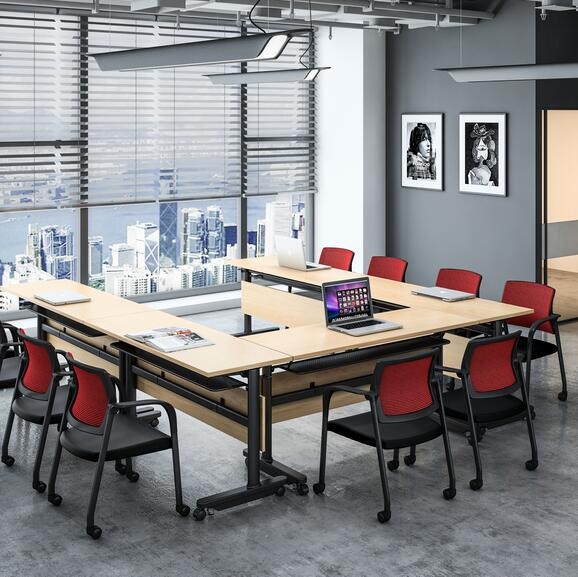
A rectangular modern conference table establishes a long working edge and a centerline for documents or displays. Available table lengths can accommodate different group sizes, but very long arrangements increase the distance between people at opposite ends. Depth can provide room for shared materials while also making the far side harder to reach. The useful size is set by the meeting task and the clearances the room can preserve.
ODEON’s fixed meeting and conference tables from Leadcom Seating stand 750 mm high, with lengths from 1200 to 9600 mm and depths from 1200 to 1500 mm. This range can support a substantial boardroom arrangement where the room is dedicated to a stable configuration. The longest versions are not interchangeable with compact tables; they demand a drawing that includes chair pullback, routes around the ends, and any screen or cable position.
In smaller rooms, a long fixed surface can occupy more area than its seating benefit justifies. Shorter rectangular modules can align for a larger meeting and separate when the group divides. Their seams and support positions must still suit the way people use documents or devices.
Rectangular corners add working edge but can project into circulation when chairs pull back. Where columns or an offset entrance narrow a path, rotating a table or using shorter units can preserve access without changing the combined tabletop area. Rotation shifts leg positions, which must be checked against the actual occupied chair layout.
The executive L-shaped ODEON format uses lengths from 1200 to 1800 mm and depths from 600 to 800 mm. Its return creates two adjacent work zones rather than a symmetrical conference group. That shape may suit a leadership office or a small meeting beside an individual workstation. It is less suited to a discussion where every participant needs an equal relationship to the center.
Consider Circles for Closer Exchange
A circular modern conference table has no ends, so a small group can face its center with less hierarchy. The tradeoff is reach and floor use: as diameter grows, the center moves farther from each seat and the surrounding chair circle expands. A compact round table can work for breakout discussions where a few people share ideas without a formal presenter.
ODEON breakout versions use round tops from 600 to 1000 mm in diameter. Those sizes can be tested with the actual chairs, laptops, and materials expected at a breakout session. A small diameter may be ideal for a short conversation but too limited for several open notebooks. The seating plan should name both the intended activity and its comfortable group size.
The family’s mobile flip-top whiteboard uses a larger round top, listed from 1200 to 1500 mm in diameter. It can become a shared writing or brainstorming surface and then move when the room resets. Its larger footprint is useful only where the room can support circulation around it and a suitable storage position. Round does not automatically mean space saving.
Placement changes how a round top works. A central table needs passage on every side; a corner position may leave seats inaccessible. Its occupied footprint includes the surrounding chair circle. Drawings should show this envelope alongside doors and nearby tables.
Round and rectangular pieces may coexist in one conference suite. A fixed main table can host formal meetings while smaller circles serve nearby informal groups. Consistent finishes can connect the spaces visually, but the shape of each table should follow its role rather than a desire to repeat one silhouette everywhere.
Match Mobility to the Layout Cycle
ODEON flip-top meeting and training formats are listed from 1200 to 1800 mm long and 800 to 900 mm deep, with castors and nesting for rooms that change layout frequently. They occupy a different planning category from long fixed conference tables. Their open size has to fit participants; their folded size and movement path have to fit the room between sessions.
A fixed rectangle suits group discussion, while round tops shorten conversational distances and mobile modules support shifting layouts. Each shape has a limiting dimension: end clearance for a long table, the occupied chair circle for a round top, and storage width for folded units. Several formats can share a building if each serves the activity that its geometry supports.