Why Pakistani SMEs Can Lose 30% of Revenue to Client Concentration (And How to Fix It)

A manufacturing owner in Sialkot told me about the best year his business ever had. One customer placed a massive order, and revenue jumped almost overnight. He hired six new people just to keep up. Eight months later, that same customer quietly moved to a cheaper supplier. Half his workforce sat idle within weeks, and there wasn’t much he could do about it by that point.
This is the kind of blind spot a business growth consultancy usually gets called in to fix almost always after the damage is done, rarely before.
You’ve probably seen some version of this yourself. A business lands a big client, revenue climbs, the team grows to match it, and everything looks strong on paper. Genuinely strong, even. But quietly, one customer starts making up 30% or 40% of total income, sometimes more. That customer becomes the foundation the whole company is standing on and, at the same time, its biggest risk.
So let’s look at why this happens, how to measure it properly, and what to actually do about it.
What Client Concentration Really Means?
In plain terms: too much of your revenue is coming from too few customers.
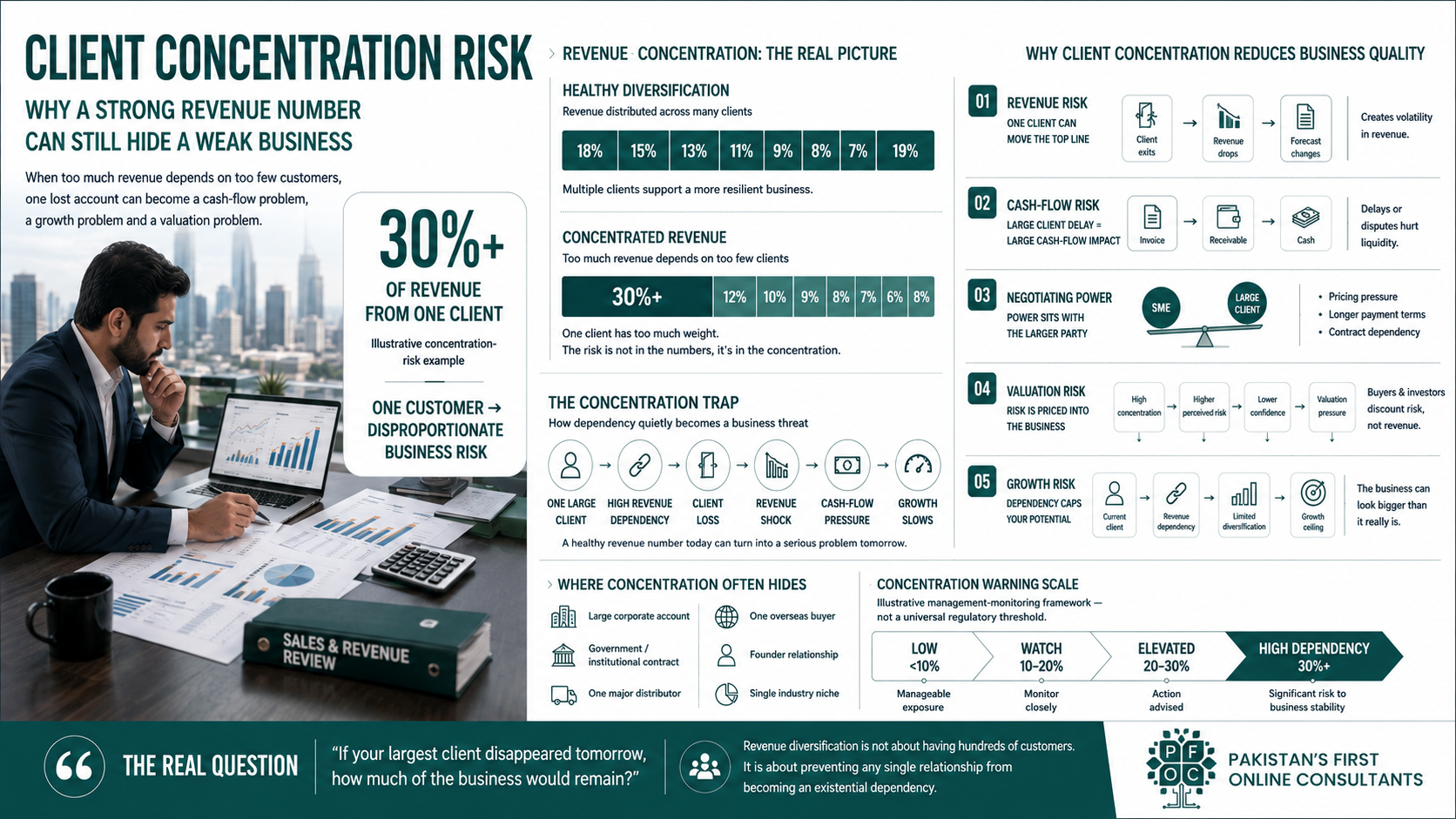
If your biggest client brings in 30% of sales, that’s concentration. If your top three clients make up 60% between them, it’s the same problem spread a little wider.
Is that always bad? Not necessarily. Big customers can genuinely fuel growth. The trouble starts the moment your business can’t survive without them.
Why Does This Keep Happening Across Pakistan?
Most SMEs don’t plan their way into concentration they grow into it without really noticing.
A lot of it comes down to referral-based growth. Business arrives through relationships rather than marketing; one happy client tells another, and before long two or three names are carrying most of the revenue sheet.
Founder-led sales plays a part too. Clients often buy because they trust the owner personally, and nobody else on the team closes a deal quite the same way.
There’s also the absence of any structured lead generation in a lot of these businesses, no real pipeline, just whoever happens to call that month. And plenty never expand past one city or one industry, so the customer pool stays narrow almost by default.
Put it together and the trap has a fairly predictable shape: a customer places a bigger order, the business leans in harder, prospecting slows because there’s less time for it, the pipeline weakens, and dependence turns into risk before anyone really decides it should.
How Much Concentration Is Too Much?
There’s no universal rule, but this is a reasonable starting point.
| Largest Customer Share | Risk Level |
| Under 10% | Low |
| 10–20% | Moderate |
| 20–30% | Elevated |
| Over 30% | High |
Where the real danger line sits for your business depends on your industry norms, your contract lengths, and how dependable that customer has actually proven to be over time.
How to Actually Measure It?
A few formulas worth keeping handy:
- Largest customer revenue ÷ total revenue × 100
- Top 3 customers ÷ total revenue × 100
- Top 5 customers ÷ total revenue × 100
Revenue is only half the story. Profit concentration matters just as much arguably more. A client bringing in 30% of revenue but only 15% of profit is a very different animal from one bringing in 10% of revenue and 25% of profit. Cash-flow and receivables concentration are worth a look too; a big customer who pays late can strangle your cash flow even while looking perfectly healthy on paper.
What Does This Actually Cost You?
Revenue risk sits at the top. Lose the client, lose that income overnight, no transition period, no soft landing.
Cash-flow pressure follows close behind, since big customers tend to negotiate longer payment terms, and someone has to fund that gap in the meantime.
Pricing power weakens too. When one client makes up most of your business, they know exactly how much leverage that gives them at the table.
Valuation takes a hit as well investors and buyers price this risk in, often more harshly than owners expect going in.
And growth itself tends to stall, since teams end up serving one account instead of chasing new business.
Run the Stress Test on Yourself
Be honest here nobody’s watching.
If your biggest customer walked away tomorrow, could you still make payroll next month? If orders dropped by 25%, how long could you actually hold on? If payments got delayed by sixty days, would your suppliers still get paid on time? And realistically, how fast could you replace that lost revenue if you had to?
If those answers made you a little uneasy, that’s useful information better to have now than after the client is already gone.
It’s Usually a Sales System Problem in Disguise
Client concentration rarely shows up on its own. Nine times out of ten it’s a symptom of something underneath: no CRM, no defined sales process, inconsistent lead generation, and a heavy reliance on referrals or the founder’s personal contacts.
The chain tends to run: no system → few leads → few clients → dependency → risk. Fix the system underneath it, and the dependency problem usually starts shrinking without much extra effort.
Reducing Dependence Without Losing Your Best Client
You don’t need to walk away from a good customer to fix this, you need to build something around them.
Protect the relationship you already have; that matters more than anything else here. Grow revenue from smaller accounts on purpose, not by accident. Cross-sell additional services into your existing client base, and look seriously at adjacent industries your product could serve just as well. Consider new cities or regions if the economics make sense, and explore partnerships that could open new customer channels entirely. Push toward recurring revenue instead of one-off orders every quarter, and build an actual sales pipeline rather than waiting for the phone to ring.
A 90-Day Plan Worth Following
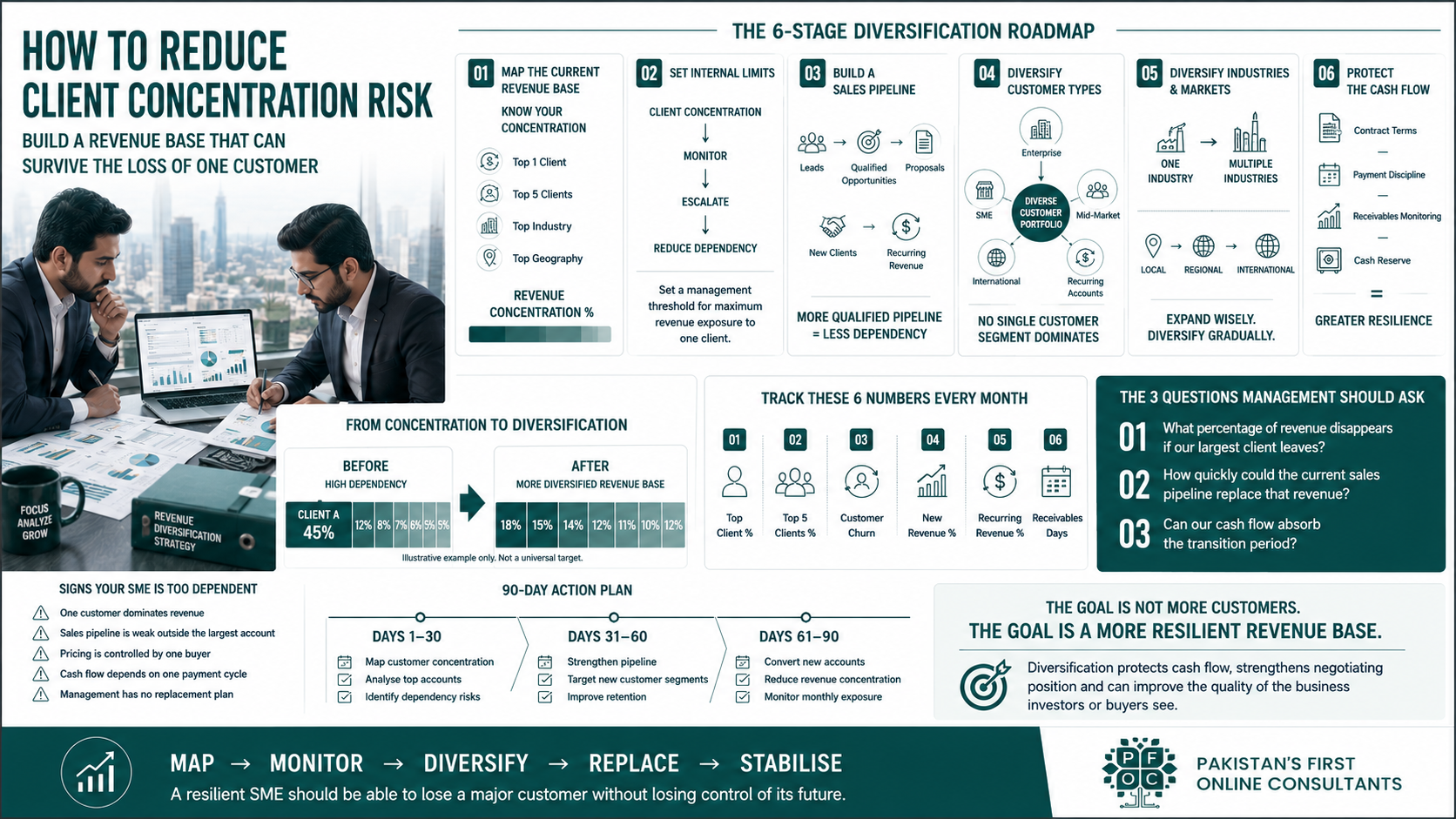
Days 1–30: Diagnose. Measure your largest customer’s share, your top 3 and top 5 concentration, profit concentration, and how exposed you are to a single industry.
Days 31–60: Build the pipeline. Put together a prospect list, set up a basic CRM even if it’s a simple one, define your sales stages, and test two or three lead generation channels.
Days 61–90: Diversify. Focus on landing genuinely new customers, testing a new industry vertical, forming useful partnerships, and growing revenue inside the accounts you already have.
A Simple Dashboard Worth Building
| Metric | What It Tells You |
| Largest customer % | Overall dependency |
| Top 3 customers % | Broader concentration |
| Profit concentration | Where real risk sits |
| Receivables | Cash exposure |
| Industry concentration | Sector risk |
| Geographic concentration | Market risk |
| Customer retention | Long-term stability |
Frequently Asked Questions
What is client concentration?
It’s when a small number of customers make up a large share of your total revenue. A single client at 30% or more is usually considered fairly high. The real risk isn’t the size of the client.it’s how much you depend on them, since losing that one account can hit revenue, cash flow, and staffing all at once.
Is 30% revenue from one customer risky?
Generally, yes especially for a smaller business without much of a cash cushion. At that level, losing the client could mean missing payroll within a month or two. It doesn’t mean the relationship is bad, just that the dependency needs managing, and most advisors would flag anything above 30% as worth addressing sooner rather than later.
How do I calculate customer concentration?
Divide your largest customer’s revenue by total revenue, then multiply by 100. Do the same for your top 3 and top 5 customers to see the fuller picture, and check profit concentration too.it often tells a very different story than revenue alone, since a customer with high revenue but thin margins may matter less than it first appears.
How many customers should an SME have?
There’s no fixed number; it depends on your industry and deal size. The real goal is that no single client can sink the business if they walk away. For most SMEs, keeping any one customer under 20% of revenue is a reasonable target, though some B2B or manufacturing businesses will naturally run higher and just have to manage it carefully.
The Bottom Line
A big client can be the best thing that ever happened to your business. It can just as easily become the single point of failure that ends it. The businesses that hold up over time spread revenue across multiple customers, industries, and channels, so growth stays predictable no matter what one client decides to do next.
This is where PFOC (Pakistan’s First Online Consultants) comes in, helping owners measure their real revenue risk and build the pipeline needed to fix it.
If any of this sounds a little too familiar, working with an experienced business growth consultancy like PFOC can be the difference between reacting to a lost client and never having to worry about one at all.